Showing posts with label French food. Show all posts

Thursday, 19 May 2016

Boiled lamb

Originally an English dish, mostly eaten in France these days, it seems.

I’m not quite sure why, but I'm rather curious about the old English dish of boiled mutton and caper sauce. Perhaps it’s a vision of the sort of people you see in Rowlandson cartoons or Hogarth paintings tucking into vast joints of meat, washed down with several pints of claret.

The Dinner. From 'The Comforts Of Bath'. Thomas Rowlandson (1756-1827). 
Handcoloured Aquatint, 1798.

According to a 2014 BBC Radio 4 documentary, mutton was highly prized in England until the 19th century, but fell out of favour and was replaced by lamb. This was partly to do with the fact that good mutton was delicious, but poor quality mutton could be very tough, whereas lamb was more consistent in its quality. In the 1960s and 1970s, the invention of synthetic fabrics lead to reduced demand for wool, which pushed sheep rearing into further decline

There have been some efforts to promote a revival of mutton, but as far as I can tell it doesn't seem to have caught on so far. I haven’t seen it on restaurant menus except in stews, and they don’t sell mutton in my local supermarket. I might try to get it from a halal butcher. According to the radio programme, the mutton sold in halal shops is fresh, and not aged in the way it would be in the English tradition, but it's worth a try, I think.

I have, however, had boiled leg of lamb, from a recipe in French Home Cooking by Paul Bocuse.


Boiled lamb seems also to have died out in England but it's a French classic, known as “gigot à l’anglaise”. Incidentally, according to various surveys, the most popular French dish is steak and chips, which may also be of English origin, as suggested by in this 17th century menu which I saw at the Musée Cognacq-Jay, listing “beef-stakes”, as well as "rosbiff".


Last weekend I thought it would be nice to have boiled leg of lamb, but the Bocuse cookbook had been packed away in anticipation of an impending house refurbishment, so I looked online for guidance. Based more or less on this recipe, I put chopped carrots, an onion studded with cloves, some celery, a head of garlic, a bay leaf, a bunch of parsley, and some fresh rosemary into a pot. I had planned to add a stock cube, but while shopping for the lamb, I found that my local Morrison’s supermarket had some lamb bones, so I used those instead. (My branch of Morrison’s are very good in that way: they regularly stock marrow bones, beef bones, chopped heart, and so on).


After adding water and bringing the whole lot to the boil, I simmered the lamb (a 1 kg leg portion, just right for two people) for about an hour. The recipe recommended 15-20 minutes per 500g but I had made a mistake and overdone it a bit. The meat was delicious and tender nevertheless. It's clearly a robust and forgiving method of cooking.

Previously, I had served the lamb with sauce gribiche, in accordance with the recipe in Bocuse. It had been a very good accompaniment but now I wanted caper sauce, which I had read about, but never before tasted. Using a recipe from the Guardian, I made the caper sauce with butter, cream, lamb stock from the cooking pot, parsley and lemon juice. I added rather more capers than they advised, which a good decision. The quantity of sauce was meant for eight people, but we found it about right for the two of us.


Served with boiled carrots and Jersey Royals, this was an excellent dish. I imagine the technique would suit the stronger and fuller flavour of mutton, and I must try that some time.

Just to finish off, this is a recipe I found on Flickr from the Bestway Cookery Gift Book (Fourth Book), published in 1929, in England.
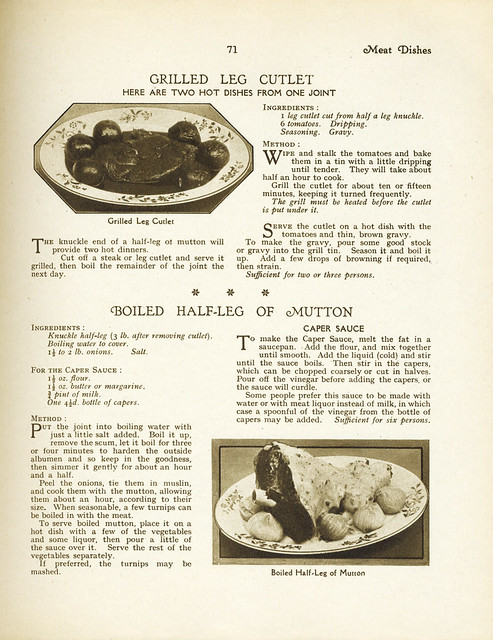
Bestway Cookery Gift Book - Boiled Leg of Mutton

I think a bit of French influence has been a good thing as far as this English dish is concerned.

Thursday, 26 March 2015

Canard à la Presse at Otto's, in London

I'm always on the lookout for classic French cuisine, which seems a bit out of fashion in London these days, more's the pity, so when I heard about Otto's from Bridie Hall, I checked it out online and was thrilled to find that they served, among other things, Canard à la Presse.

The dish originated in Rouen in the early 19th century, and was made famous by the legendary Tour d'Argent in Paris. A duck is roasted rare and carved, and served in different ways, but the key feature is a specially constructed press which is used to squeeze all the juices out of the carcase, which are then used in the sauce. I'd heard about it before, and had always wanted to try it. Now was my chance. It's a luxury dish for a special occasion, but my birthday was coming up, which was a good pretext.

Otto's is a small restaurant on Gray's Inn Road, not very conspicuous from the outside. The interior is narrow, with tables reasonably close together on the ground floor as well as in the basement. It's furnished eclectically, with reproductions of classical greek friezes, large black-and-white portraits of actresses from the 50s and 60s, and a wide variety of silverware, and objets d'art, some of it quite old.


We were shown to a table in a corner, close to the entrance to the kitchen, and warned that there might be a wait of 45 minutes. We shown the menu in case we wanted a starter. They looked very tempting, but after some consideration we declined. A wise choice as it turned out

The duck was produced. It was very large. Otto uses Challons ducks from France, a breed regulated under the French Appellation Controllée system. Each duck is numbered; ours was No 2009. The duck was taken away for preparation.


After a while the owner Otto came up to the table and started preparing the sauce on a 1910 Christofle trolley, explaining each step as he went along.

We chatted to him while he was at the table. I wondered where he had learnt the technique. It turns out that he had worked in Paris at the Tour d'Argent in the 1970s, as well as at Maxim's and at the Plaza Athenee. Shortly after that time, Maxim's was taken over by Pierre Cardin. I remember they  had a brief period of global expansion and even had a branch in Singapore in the 1980s, but in the end the expansion didn't quite work out. Otto reckoned that Maxim's had a part in the downfall of the Shah of Iran, when they provided the catering for the Feast in the Desert, a lavish celebration of the 2500th anniversary of the Persian Empire which cost at least $17 million, and which not go down well with his subjects.


The liver is used in the preparation of the sauce, then strained, taken away, and after some preparation in the kitchen, brought back on brioche toast, accompanied by a cup of Muscat de Beaumes de venise.


The roasted duck was brought to the table, the breast carved into thin slices, the legs taken back to the kitchen.

Then came the pressing. The carcase was put into the press, which is a bit like a printing press with a bell-shaped contained that accommodates the duck. I was invited to participate in the operation. The screw is turned, and all the juices are squeezed out. These are collected and used to make the sauce. The press was made specially for this purpose in the early 1900s. Like the serving trolley, it was made by Christofle (are you beginning to see a pattern here?)


When the sauce is ready, the slices of breast are served with it. It's incredibly rich tasting, and delicious. They are accompanied by french beans and souffle potatoes, the later being like ultra-light air-filled fries.


The legs are served as a second course, accompanied by a frisée salad, crouton, bacon lardons and pieces of crisp duck skin.


There was no room for dessert. In fact, being a little out of practice, I decided to forgo my usual post-prandial coffee, and to have a mint tea instead. This, by the way, is scientifically proven to be effective in this situation. Mint is used by doctors for a number of gastrointestinal applications which I will not go into here.


It was great to find a restaurant serving classic French cuisine. It's nice that it's furnished to the owner's taste, with bits and pieces he has added to it, rather than being designed within inch of its life.  Otto is something of a collector, and he is keen on silver. Apart from the serving trolley and duck press, there are other items including a couple of giant samovars. As we were chatting, he brought to our table a glass duck from the Tour d'Argent, made in the 1950s.

The meal we had was a wonderfully theatrical experience, and every bit of it was delicious. I'd have it again, but not before trying some of the other things on the menu. The standard menu looks fantastic, and as special dishes, they also do Lobster à la Presse, with a special silver lobster press (Christofle, of course), and Poulet Demi-Deuil: chicken with fresh truffles under the skin. There is an extensive wine list, by the way, on which I am not qualified to comment, but it looked pretty impressive to me, and we enjoyed the bottle we ordered.

It was a tremendously enjoyable evening. I'm sure I would have had a good time had I tried the pressed duck at the Tour d'Argent in Paris, but I've got a feeling that Otto's might be more to my taste.  There are also rumours that things at the Tour are not as they used to be: pre-prepared sauces for their Canard à la Presse, and that sort of thing.

There were so many other dishes on the menu which I want to try, and I'm definitely coming back for more.

Otto's
182 Gray's Inn Road
London  WC1X 8EW
http://www.ottos-restaurant.com/