Showing posts with label walking. Show all posts

Thursday, 3 September 2015

Carrying on walking to work, even if it's a bit wet

With the right kit, one is less inclined to hop into one's car when things get a bit wet.


After a dry spell, there's been a bit of rain and mud, so it's back to having a waterproof jacket to hand when I walk to work. It's not much fun being caught unprepared and getting drenched, but this tends not to happen. Weather forecasts are reliable most of the time, and having the right kit helps.

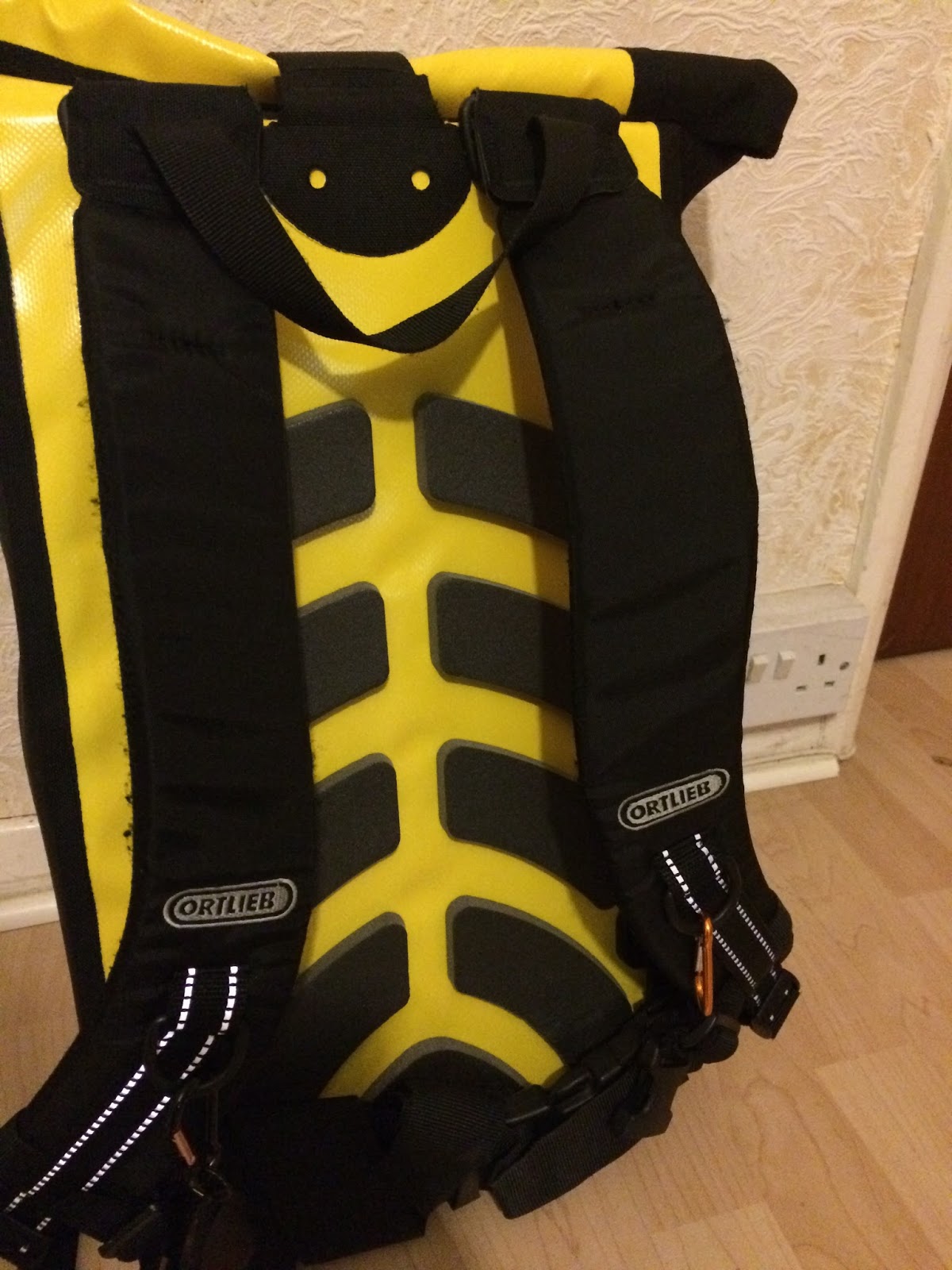
If you carry things in a backpack, you'll realise that most of them are not waterproof, and your stuff can get wet, which is not great if you're carrying books or electronic devices. Eventually after a bit of online research I got a backpack from Ortlieb, the German manufacturer of waterproof outdoor bags. It's a "Velocity" with a capacity of 20 litres, and is designed for cycling so you can attach an LED light or your helmet to the back. It's totally waterproof, robust, and will hold all the stuff I need to take to work.


Foam strips at the back hold it slightly away from the body and stop things getting too sweaty, and it has a waist belt and chest strap which might come in useful when I get my bike fixed. Its pretty comfortable to carry, and I'm glad I got it.

There is an alternative to waterproof jackets and bags: I've also got this poncho from Rohan, which is very cleverly designed. They call it a Canopy Cape. It's made from fabric derived from flysheets used in mountain tents: very light, silicone impregnated, and water-shedding. Although it's like a poncho, it actually has sleeves.


It packs neatly into its own front pocket which becomes a zip up pouch. It slips on very easily and will go over you and your  backpack, satchel and whatever else you happen to be carrying, so you don't actually need a waterproof bag. It's well ventilated because the sides are open, held together at intervals with press studs. When you no longer need it, it stows into the zippered front pocket with all the wet bits inside so you can pop it back into your bag without getting the contents wet.


As a bonus, there are handy loops at the side and you can join two of them together to make a tent.


It's not just the rain which can make the walk problematic in this sort of weather. My route to work includes a footpath by the side of some fields, and this can get muddy if it's been raining.


For some time I've been putting my work shoes in my backpack, and walking in wellies if I think the route might be muddy. Mine are made by Aigle, and are supposed to have soles like hiking boots. They certainly seem comfortable for walking, so while I haven't done any comparative testing, I'm glad I chose them.


An option which I haven't actually used, is this pair of "festival feet" overshoes, costing £3 from Tiger, which might come in handy at a pinch.


The problem is dealing with them once I get in to work, which I haven't really thought through. They could be chucked into a plastic bag, but then they might need to be taken out again for the walk home, and so on.

There's supposed to be a Norwegian saying: "There's no such thing as bad weather, only bad dressing". I wouldn't quite agree with them, but I have found that the right "dressing" does help.


Friday, 15 May 2015

From Hackney to the Walthamstow Wetlands

Last Saturday I joined a sponsored walk organised by the Hackney Society to raise funds for a book they are planning to publish. It took us from Hackney, via the Olympic Park, to the Walthamstow reservoirs. We covered, I believe, about 20 kilometres.

Arriving in good time, I saw this shellfish stall by Hackney Central Station, with its semicircular brick base and golden roof topped with fish scales, and surmounted by a fish tail. 


They were just setting up when I arrived but I could see that they had an impressive range of shellfish, including oysters and mussels. I returned a little later to pick up some crab for breakfast, which was a very enjoyable start to the day. 


They only open at Hackney on Saturdays, according to the owner, but can be found at Dagenham market on Sundays. The business was set up by the owner's grandfather operating from a barrow. In the 1970s, the railway company tried to get rid of them, but ruts in the pavement proved that they had been there long enough to have squatter's rights, so they stayed put.

We met up at St Augustine's Tower, the oldest building in Hackney, and looked after by the Hackney Preservation Society. It's currently managed by the Hackney Historic Buildings Trust, and normally only open on the last Sunday of each month but it was open for the group, so I took the opportunity to climb up, where I got to see the historical clock mechanism, as well as the view from the top.


The route took us along a canal with tantalising views of cafes on the other side, which I resolved to explore in future.


We didn't linger at the Olympic Park, and I only got to see bits of it, but was impressed by the way it had been laid out, by the buildings, and by the way the gardens had been planted to blend in with the natural landscape of the Lea valley.

Our final destination was the Walthamstow Wetlands. This is an area occupied by 10 reservoirs that supply tap water to about 1.5 million people in London, operated by London Water. At the same time it is also a Site of Special Scientific Interest, and home to many species of migrating birds and other wildlife. It's very close to the centre of London, and the largest urban wildlife reserve in Europe. At present it's only open to anglers and birdwatchers with permits, but is being developed as a nature reserve and wetland centre that will be open to the public in about two years' time. Currently it's open to groups by arrangement. We were in fact the first group to visit and were shown around the site by their community engagement officer. It's a spectacular place with large bodies of water, and lots of birds and waterfowl.


If you like pylons, as I do, this is a good place to see them, and to get close up. Recently, as you may be aware, a new design was adopted after a competition. I'm not sure that I like it, but only time will tell, I suppose. Incidentally, if you are a real enthusiast, you might wish to join the Pylon Appreciation Society.


What I particularly liked was the juxtaposition of wildlife and the urban environment, of the natural and the man made: the buildings and warehouses by the edge of the water, the views of Canary Wharf in the distance, and the geese wandering amongst the electricity pylons, and the trains passing regularly nearby.


Within the site, there are two significant buildings, the Victorian Marine Engine House, which will be used as a visitor centre:


and the old Coppermill building, which as it's name indicates, was once a copper mill.


It's going to be amazing when it opens to the public, and I'll be following their progress with interest.

Friday, 24 April 2015

On St George's Day, I Explored my Little Corner of England

I had a half day off at work today, and set off for home on foot on a fine, bright, sunny afternoon. On an impulse, instead of cutting across it as I usually do, I turned right and to explore for the first time one of the two woodlands within the hospital grounds. This one is known as the Long Shapely Belt. I followed the path  along the edge of the hospital, with trees on either side, and two pretty ponds on the left.


At the end of the wooded area there path led to a gap in the trees, and continued out of the hospital across a large, right yellow field of rapeseed with the bright yellow flowers in full bloom.


Straight ahead in the distance I could see the tower of the Melbourne Road flats close to my house, so checking my route with google maps on my phone (satellite view) I strode off along the path.


At the end of the path, my way was blocked by a row of trees, so after checking the google satnav again, I decided to turn left. After a bit there was a gap in the trees, with a path going through it and a signpost helpfully confirming that this it was a public footpath, so I carried on.


After a bit I arrived at a lovely farmhouse which was the same one I usually walk by on the road, but from this vantage point I could see that it was a rather fine building, which I had not previously realised.


Looking around for a way through I was fortunate to encounter someone who pointed me in the right direction, over the stile and across more fields.


And so I eventually got home along a route roughly parallel to my usual one, but more or less entirely across open countryside. It took rather longer than usual because I had to check my position and took a few wrong turns, but I think it is probably a feasible alternative route for my regular commute on foot.

Two days previously, I had on another impulse gathered dandelion leaves on my way home with thoughts of using them for salad, perhaps a salade de pissenlits au lardons. I knew that it was best to get the small young leaves, before the flowers appeared, but I wasn't sure if these would be suitable, and indeed they were a bit bitter, but I did wonder if they would be good stir fried.


A little online research confirmed that this would probably be fine, so for dinner this evening, for our dinner on St George's Day,  I stir fried our English dandelion leaves in cold pressed extra virgin English rapeseed oil with garlic, as an accompaniment for grilled English lamb cutlets. To drink we had an excellent Saling Gold from our local Round Tower brewery.


We also had on the side some aubergine dips made by Sabra, which, as I discovered by chance, was the name of the princess that St George rescued from the dragon. A most enjoyable meal.

This is the first time I've eaten dandelion leaves. They have a nice texture and are rather bitter, but I quite like that. They are an excellent alternative to kangkong which is quite difficult to find in England, and I'm sure they are good fried with sambal belacan, or cooked in coconut milk. In fact, it appears that they they're eaten in Indonesia, where they are known as randa tapak. I think I'll be doing a bit more foraging.

Thursday, 16 April 2015

The Parish Church of St Mary with St Leonard, Broomfield

For the past fortnight, since my last post on the subject, I've been walking to work most days, and feeling the benefit. It's somewhat more exercise than I've been doing recently, so it's a little tiring at the end of the day, and I get a bit footsore sometimes. I could use my bike on some of those occasions when I've driven, except that some time ago I noticed that one of the tyres was almost worn through, and I haven't got round to sorting it

The last two days have been unseasonably warm, bright and sunny, and the fine weather encouraged me to linger on the way back. I stopped by the Church of St Mary with St Leonard, and had a stroll around the grounds. This is the parish church of Broomfield, the village my workplace is located. The oldest parts of the church date from the 11th century (older than Chelmsford Cathedral), although there have been many additions over the years.


The round tower is one of the oldest parts of the church and is Norman, from the 12th century. Many of the bricks in the tower and the older parts of the church are re-used Roman bricks.


The additions from different periods, with different building materials, are clearly visible and add to the charm.


There is a lovely churchyard with interesting gravestones like the one shown here.


The church itself was closed, so a visit to the interior will have to wait, but I found this plan, along with a detailed description at British History Online.


St Mary with St Leonard, Church Green, Broomfield, Chelmsford, Essex CM1 7BE