Showing posts with label design. Show all posts

Sunday, 30 October 2016

More from the London Design Biennale 2016

A few other brief snippets from the London Design Biennale, where the theme was Utopia, interpreted in a variety of ways at different national pavilions

China:
Shenzhen: New Peak by URBANUS

The population of Shenzhen, just across the border from Hong Kong, has grown in 35 years from 300,000 to over 17 million. In this exhibit, the architecture team from URBANUS illustrated a proposal for a megastructure, as an alternative to urban sprawl. In the middle was a model of the megastructure. What struck me was that it was not a solid monolith, but had lots of openings and spaces within it, so that there would be lots of light and fresh air even in the middle of the structure.

There’s nothing new in the concept of a megastructure housing an entire city, but I thought this one was rather well illustrated, with a video on the wall of the pavilion showing it being built on the proposed site, and another animation showing what life might be like in one of these  places.

I’m sure that none of the technical issues have been worked out, and I don’t know if such a structure could actually be built. The animation did look a little like a video game, but it was nevertheless a seductive vision. If something like that were to be built, I’d quite like to visit.

More details from the designers' page here.

Israel:
AIDrop by Yaniv Kadosh

This is a system which allows 3 kg packages of  supplies to be air-dropped to disaster zones. The payload is carried in a unit, inspired by the sycamore tree, which rotates and thereby slows its descent without the need for a parachute.


This seemed like a clever idea. The item itself was on display, and it would appear that it has actually been tested and does work.


Here is the designer's website.

Taiwan:
Eatopia by Rain Wu, Shikai Tseng, et al

This was a beautifully designed room, with dishes laid out on a table. The food was meant to “explore the creative melting pot of Taiwanese identities”. It looked pretty, but unlike the Lebanese pavilion, it was not for public consumption, except during special events. No matter, it was lovely to look at, and enjoyable to walk through.


Finally, 
here is something I saw by the reception desk at the Spanish pavilion which you could make yourself for your own home:


Thursday, 13 October 2016

Two versions of socialist utopianism at the London Design Biennale

The theme of the 2016 London Design Biennale, was “Utopia”. This was explored in many different ways in the various national pavilions. The displays ranged from the abstract and conceptual, to practical projects and real objects, intended for use in the real world.

Two fascinating pavilions were those of two former socialist countries, Russia, and Chile, showing two different aspects of socialist utopianism.

The Russian exhibition, Discovering Utopia: Lost Archives of Soviet Design, was a catalogue of projects from created at the All-Union Soviet Institute of Technical Aesthetics (VNIITE) and Soviet Design Studios (SHKB) between the 1960s and the 1980s. Here were the designs for products which would contribute to realising the socialist utopia. The institute employed not only designers, but also philosophers, sociologists and historians of art and culture. On display were a wide range of products: vehicles, trains, a hydrofoil, kitchen utensils, electronic goods (including a precusor of modern computers and tablets), and much more. Some of these went into production, like the hydrofoil which was exported to Britain, but most were never realised due to economic or technical constraints.


Here are some examples of the projects, from the website of the Moscow Design Museum


Seating in this section was provided in the form of cardboard chairs, made from an old Soviet design discovered by the curators. They were very comfortable, in fact. But note, should you be tempted to have a go at making one, that the cardboard from which they were made was of a heavier grade than that used for your usual mail order delivery.


The Chilean pavilion, The Counterculture Room, was an exhibition about the Chilean Cybersyn project, which took place from 1971 – 1973 during the time of the socialist president Salvador Allende. Using the computer technology available at the time, such as telex machines, the aim of the project was to provide the government with real time data that would help them run the economy. The architect of the system was an English business consultant Stafford Beer. This was a sort of precursor of the internet and “big data” of today. The experiment ended with the assassination of Allende in a military coup.

The heart of the display was a reconstruction of the operations room , deigned by Gui Bonsiepe, with its futuristic swivel chairs, and screens for displaying data. Each chair had a control panel on one of the armrests. On the other armrest was that other essential accessory of the period, an ashtray.


Here are some images of the original design and the original room:


You can find out more about Project Cybersyn here http://99percentinvisible.org/episode/project-cybersyn/

That's all for today. There was lots more at the biennale, so please come back next week.


Friday, 7 October 2016

London Design Biennale 2016: Lebanon and South Africa

A Beirut Street, and Giant Stuffed Animals

At the first London Design Biennale, held at Somerset House from 7 - 27 September this year. There were 37 countries represented, each with their own installation, on the theme of Utopia. The exhibits ranged from the highly conceptual, to collections of practical objects. I thought it was a good selection, and immensely enjoyable.

Here are two of them, to begin with.

Lebanon
Mezzing in Lebanon

This was a delightful outdoor installation on the terrace, a re-creation or re-imagining of the streets of Beirut, with a barber shop cum mini-cinema, rooms for relaxing and playing board games, a quilt maker, and food and drink stalls.


The food was by a well-known London restaurant, Momo. I have never been to Momo, but the shawarma was delicious, so it's on my list. I've never been to Beirut either, but now I'm curious, and the UK government advice is that it's only moderately dangerous, so we'll see.


South Africa
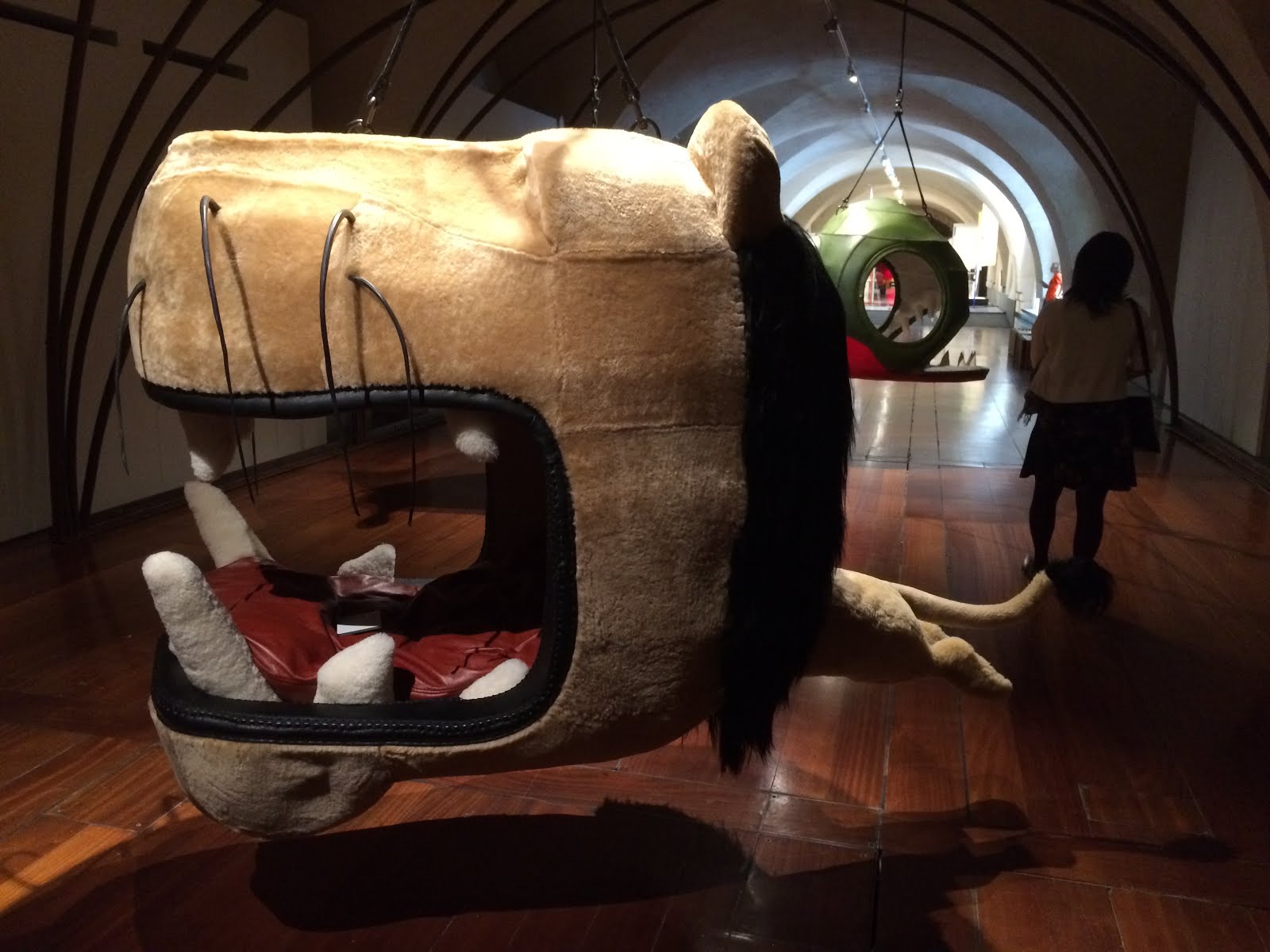
Otium and Acedia

Hanging nests in the form of ferocious animals. They were charming and funny.


I'm sure, like me, everyone must have been wondering what they would be like to sit in, but that was forbidden. This was as close as I got.


You can see more of the designer's work in his website, which is worth a visit.

That's all for today.
More next time.

Thursday, 18 August 2016

The Nomadic Community Garden. Revisited.

I was in the area last Sunday, and not having been since my visit last year, I decided to pop in to the Nomadic Community Gardens. 

I chanced upon this extraordinary place a year ago wrote a post about it. I kept meaning to revisit but never got round to it until now.

The Gardens were set up on a large plot of land in Shoreditch, that had been bought for development. Building work will not occur for a while. In the interim, with the permission of the developers, the area has been turned into an extraordinary amenity for local residents and visitors, a sort of pop-up park and allotment complex.

There are several parts to it. There is a recreational area with tables, seating, stalls and play areas. Then there are the allotments, based on pallets, on which boxes are mounted, in which things can be grown. These can be transported easily, so that when the site is reclaimed by the developers, they can be moved on, hence “nomadic”. It's a brilliant way to utilise a vacant plot of land, if you might have to move on.

Everything is made from donated, recycled, and upcycled materials. The results are a real eye-opener, a reminder of how much our society discards. The garden has of benefitted from the high concentration of artists in the area, many of whom have contributed to building and decorating the area.

Since last year, there have been some changes and additions, as you might expect. The place looks busier, with a few more stalls, more seating, and more art.

This is the approach, under a bridge:


This is just beyond the entrance:


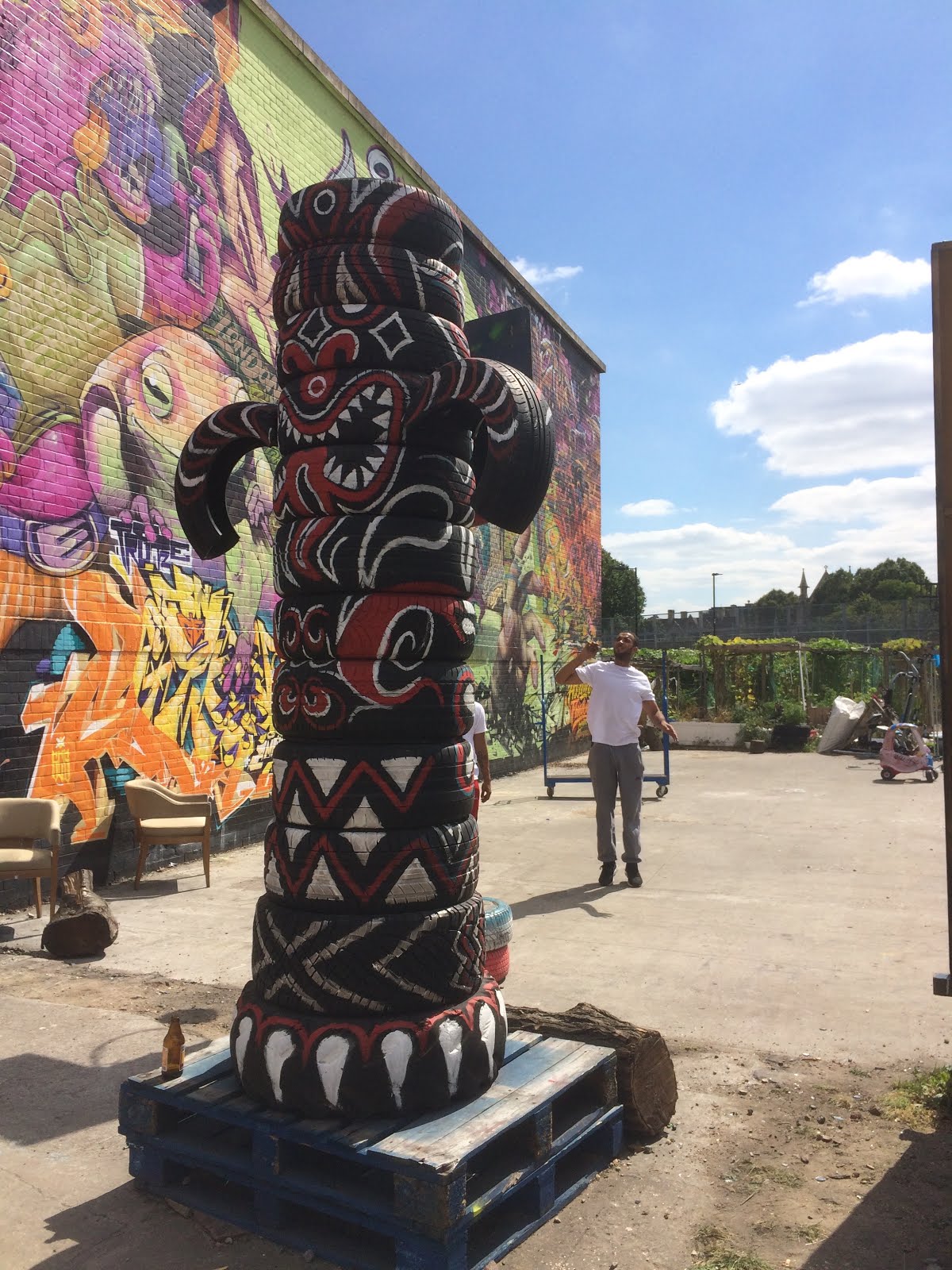
One of the areas for chilling out. Note the extensive use of pallets for furniture, old tyres for planters and ornaments, the cooking area sitting on a pallet, and the charming alcove-like area beyond it to the left.


The allotments are still going strong


and they seem to be doing something with biochar, although I'm not clear what that is exactly.


(More details about biochar here)

There are various other things for the local community, like this space where old clothing can be donated.


Here's another chilling out area. Note the uprights supporting the roof, made from wood with the old tyres at the bottom.


This is the bush next to it. Do you see the faces?


More old tyres, stacked up to make a totem pole.


A vulture, perhaps. A scavenger bird, made from scavenged materials.


The Gardens are often used for concerts and other events. And soon they will have a theatre. This domed wooden building was a bit of a surprise. It wasn't there when I had visited last year, and unlike the other structures, which were attractive but had a makeshift quality, this was a finely crafted construction, a wooden rotunda with a domed roof.


The theatre is the work of a talented chap called Selim, and he is building it all on his own. Here he is, working inside. He does this sort of thing for a living as well, and describes himself as a man with OCD, "obsessive construction disorder".


All the material for the construction was salvaged. Nothing was bought. The building is made entirely of wood, which makes for good acoustics. I thought the acoustics were pretty good, but I was assured that they would be even better after the oculus at the top of the dome had been covered with perspex.

The theatre should be completed in a few weeks’ time, I was told. The plan is to have an inaugural concert of operatic works. That sounds like a terrific idea. I don't like the way classical music gets poshed-up, and I think that the Nomadic Community Garden would be an excellent setting for a bit of opera. I hope I'll be able to attend.


Related:
My previous post about the Nomadic Community Gardens.
Another pop-up garden: The King's Cross Skip Garden


Nomadic Community Gardens
Fleet Street Hill
London E2 6EE
Usually open daily until about 11 pm.
Also on Facebook and Twitter

Thursday, 5 November 2015

Batik and Wax Fabric: From Indonesia to Africa, via Holland

I thought there was something a bit familiar about those African fabrics


(Photo from The Wax Sellers of Wentworh Street by the Gentle Author of Spitalfields Life)

Some time ago while wandering around the streets around Wentworth Street, off Brick Lane, where there are numerous shops selling African fabrics, I was struck by how a lot of them reminded me of Indonesian and Malaysian batik. Looking a little more closely I saw labels which said things like "genuine Holland wax". So I did some research, and guess what? It turns out that there is in fact an Indonesian connection, via Holland.


Batik is a technique of wax-resist fabric dyeing which has been practised in Indonesia and maritime South East Asia for centuries, most notably on the Island of Java. The process involves applying a design to cloth with wax, and then dyeing the fabric. The parts of the cloth not covered by wax take up the dye, while the parts covered by wax do not. The wax is then removed from the fabric, and the process can be repeated as often as desired to build up the design. As you can imagine, this is a slow, painstaking and highly skilled technique, and Indonesian batik is on the UNESCO Representative List of the Intangible Cultural Heritage of Humanity.

This video shows the process:


Indonesia was a Dutch colony until 1949, and the Dutch exported batik to West Africa from the mid 19th century. Towards the end of the 19th century, machinery was invented which could replicate the wax resist process more swiftly, and this gave rise to the African wax fabric prints as we know them today.

The machine-produced batik was not popular in Indonesia, but was popular in Africa. One theory is that West African troops serving with the Dutch forces in Indonesia brought batik back home to Africa, where it was well received. The early fabrics were imitations of Indonesian batik, but the manufacturers later began producing prints aimed specifically at the African market. To this day, although there are now producers in Africa,  and—of course—China, the high end of the market remains dominated by Dutch companies like Vlisco, whose entire output is for the African market. 

Although these fabrics are quintessentially African, they are designed and manufactured abroad. This raises some interesting issues, as you might expect. Critics of the industry have suggested that it represents a continuation of colonial endeavour, and argue that Africans should wear clothing designed and made closer to home. This whiff of colonialism is perhaps the reason the artist Yinka Shonibare includes wax fabrics in his work, as in this example :

Africans may buy their fabrics from Europe today, but there was a time in the past when Europeans had to journey abroad to buy the luxury goods which they were unable to produce themselves, such as Chinese silk during the time of the Roman Empire,  chintz and other luxury fabrics from India from the 17th century (currently the subject of an exhibition at the Victoria and Albert Museum), or porcelain from China, which was not produced in Europe until 1708 (at Meissen). I don't know much about the  textile industry or Africa, but my optimistic view is that it's only a matter of time before fabrics are produced and designed in Africa, by African companies, which will compete with the products from abroad.


I never get tired of wandering around the Wentworth Street area and marvelling at the multitude of wax designs. Some are quite similar to traditional Indonesian batik, but from the early days, many of the fabrics incorporated motifs and images from modern life. They often have stories or symbolic meanings associated with them. This famous Vlisco design from 1940 is called "Six Bougies". The bougies are spark plugs, meant to show that the wearer is wealthy and owns a six-cylinder car, but there is another meaning: that he woman in the centre of the design is strong enough to take on six men. 


Motifs found on more recent fabrics include laptops and mobile phones. Others—like the one entitled Michelle Obama’s Handbag, or Kofi Annan's Brain—pay glorious homage to contemporary events. 

Kofi Annan's Brain

They’re mathematically interesting, too: within the frame of a single shop window you can see anything from regularly repeating motifs to some whose placement seems quite chaotic. There’s never been an occasion where a second, closer, look at these fabrics has gone unrewarded.


I've been wondering for some time if these African batiks would work on traditional South East Asian clothing, like the sarong kebaya.

"Kebaya 1" by Jamieson Teo from Singapore, Singapore - _MG_8051. Licensed under CC BY-SA 2.0 via Commons  https://commons.wikimedia.org/wiki/File:Kebaya_1.jpg#/media/File:Kebaya_1.jpg

After all, the batik shirts commonly worn in Indonesia, Malaysia and Singapore, like the ones seen here, worn by Indonesian President Joko Widodo and politician Prabowo Subianto:


...have quite a lot in common with the sort of garment favoured by the late Nelson Mandela.


And perhaps nowadays there might be a market for Southeast Asian batik in Africa.

A small correction:
It turns out that Mandela's shirts were made from Indonesian batik, and batik shirts are known in South Africa as a 'Madiba shirts" http://www.bbc.co.uk/news/blogs-news-from-elsewhere-25258953

Further reading:

Made in Holland: the Chanel of Africa by Inge Oosterhof. messynessychic.com, 2015

When It Comes to African Wax Prints, Buying Local, Thinking Global Isn’t As Easy As You Think African Urbanism, 2012

Africa's Fabric Is Dutch Robb Young, The New York Times, 2012

African Lace: an industrial fabric connecting Austria and Nigeria Barbara Plankensteiner. Anthrovision, 2013

The Wax Sellers of Wentworth Street, by the Gentle Author