The Musée Cognacq-Jay, located in the district known as the Marais, is devoted to the art of the 18th century and houses the collection acquired between 1900 - 1927 by Ernest Cognacq, founder of the Samaritaine department store, and his wife Marie-Louise Jay. In addition to a fine collection of paintings and sculpture, the collection includes porcelain, furniture, silver, snuffboxes, and other decorative items, all beautifully displayed in the Hôtel Donon, a house from the late 16th century.

Among other things, I was pleased to see a small selection of paintings by the Venetian painters Canaletto, Francesco Guardi, Francesco's son Giacomo, and by imitators. I'm rather keen on Francesco Guardi, who was the subject of my MA dissertation. I had not seen this collection before, and it was interesting to have similar works by artists of varying quality displayed sided by side.

The big, famous museums like the Louvre, or the Musée D'Orsay are of course wonderful places to visit, but smaller museums have their appeal too, and in a different way. The grand museums are so large that it's impossible to see more than a small sample of their collections in a single visit. with smaller museums, it's usually possible to take a more leisurely perambulation through the displays, and I find that the smaller scale of the rooms creates a more relaxed framework in which to view the exhibits. In great tourist cities like Paris, the lesser-known museums also tend to be less crowded, which is a great bonus, I find.
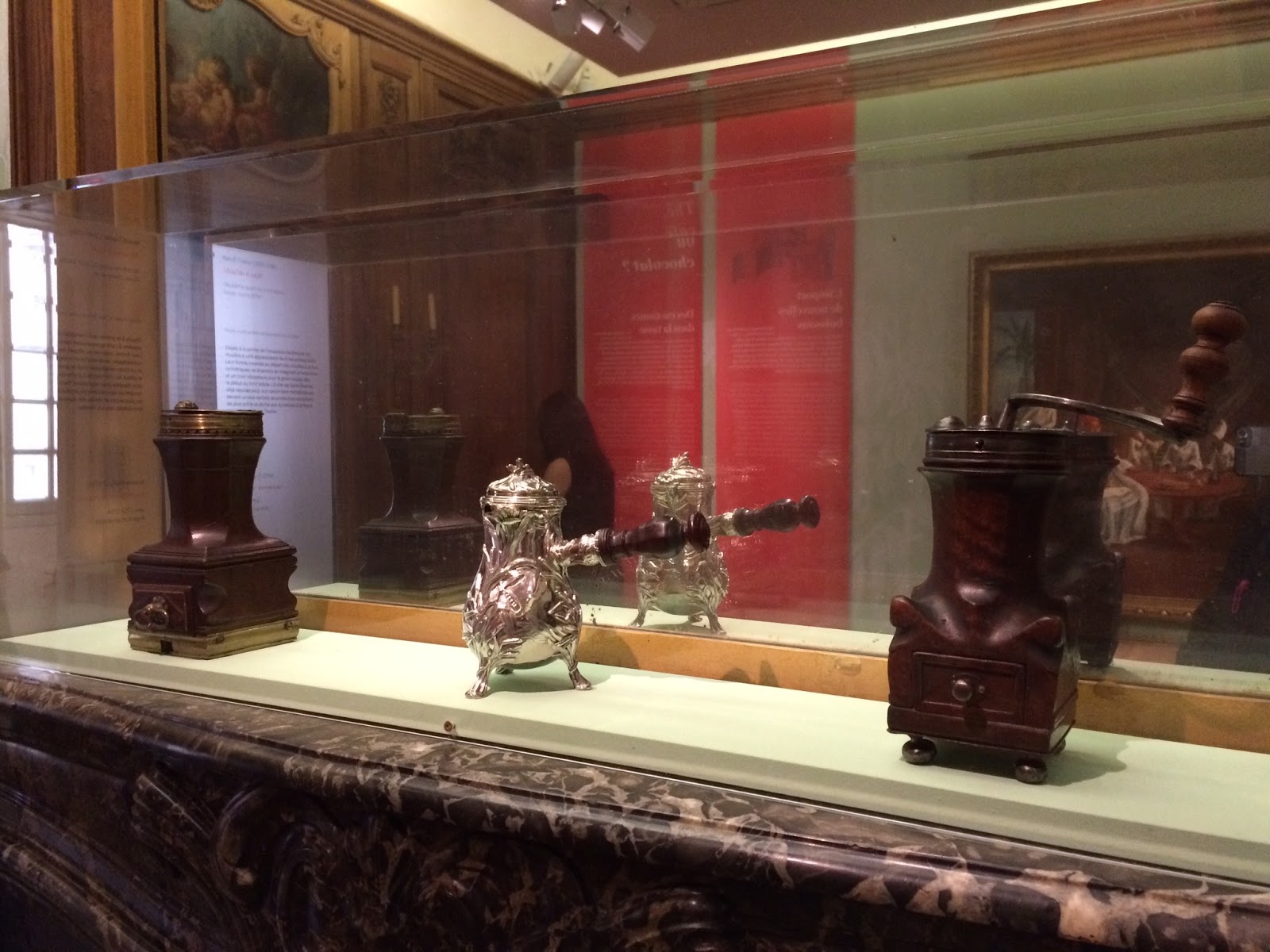
During our visit to the Musée cognac-Jay, there was also an exhibition about the history of tea, coffee and cocoa in the 18th century, which was informative and enjoyable.

Among the exhibits, this 18th century menu offering a few "English" dishes: Rosbiff and several variants of Beef-stake.

In the courtyard, a pop-up café offered Espresso Tonic: espresso in tonic water.

Unlikely as it might seem, this is rather nice, but if you make it yourself, pour the coffee very slowly and carefully into the tonic, or the whole thing will froth up all over the table, as I found.

Among other things, I was pleased to see a small selection of paintings by the Venetian painters Canaletto, Francesco Guardi, Francesco's son Giacomo, and by imitators. I'm rather keen on Francesco Guardi, who was the subject of my MA dissertation. I had not seen this collection before, and it was interesting to have similar works by artists of varying quality displayed sided by side.

The big, famous museums like the Louvre, or the Musée D'Orsay are of course wonderful places to visit, but smaller museums have their appeal too, and in a different way. The grand museums are so large that it's impossible to see more than a small sample of their collections in a single visit. with smaller museums, it's usually possible to take a more leisurely perambulation through the displays, and I find that the smaller scale of the rooms creates a more relaxed framework in which to view the exhibits. In great tourist cities like Paris, the lesser-known museums also tend to be less crowded, which is a great bonus, I find.
During our visit to the Musée cognac-Jay, there was also an exhibition about the history of tea, coffee and cocoa in the 18th century, which was informative and enjoyable.
Among the exhibits, this 18th century menu offering a few "English" dishes: Rosbiff and several variants of Beef-stake.

In the courtyard, a pop-up café offered Espresso Tonic: espresso in tonic water.

Unlikely as it might seem, this is rather nice, but if you make it yourself, pour the coffee very slowly and carefully into the tonic, or the whole thing will froth up all over the table, as I found.
The other, even smaller museum I visited was the Musee Zadkine, contaning works by the sculptor Ossip Zadkine (1890 - 1967), and housed in his former studio. The street entrance is rather inconspicuous, and it's easy to walk right past it, as I did.

Zadkine was born in Russia. Sent to Sunderland in England to study English, he began to attend art classes, and moved to London in 1906 where he studied sculpture. In 1909 he moved to Paris where he spent the rest of his life, apart from a period of exile in New York during the second world war, and he was friends with Appolinaire, Picasso, Brancusi, and Eileen Gray.
The museum houses examples of his work from the start of his career, right up to those produced towards the end of his life. These are situated both inside the building, where the white walls and natural light set them off marvellously, as well as in the small garden.


Admission is free, but there is an audioguide in French or English for 5 Euro. Apart from discussing the background and context of the sculptures, it also it describes how the works were made, and aspects like the subtle application of pigment to what I took to be unfinished wood or stone, which I found particularly interesting. Audioguides can be variable in their quality, but I thought this one was well worth the money.


I enjoyed the visit immensely, much more than I did an earlier visit to the better-known and larger Rodin museum. I think I rather prefer Zadkine to Rodin, in fact.
Musée Cognacq-Jay
8 Rue d'Elzevir, 75003 Paris
http://www.museecognacqjay.paris.fr (in French only)
Musée Zadkine
100 bis, rue d'Assas, 75006 Paris
http://www.zadkine.paris.fr/en
Both museums are open 1000 - 1800 daily except Mondays and Public Holidays


