Showing posts with label park. Show all posts

Thursday, 18 August 2016

The Nomadic Community Garden. Revisited.

I was in the area last Sunday, and not having been since my visit last year, I decided to pop in to the Nomadic Community Gardens. 

I chanced upon this extraordinary place a year ago wrote a post about it. I kept meaning to revisit but never got round to it until now.

The Gardens were set up on a large plot of land in Shoreditch, that had been bought for development. Building work will not occur for a while. In the interim, with the permission of the developers, the area has been turned into an extraordinary amenity for local residents and visitors, a sort of pop-up park and allotment complex.

There are several parts to it. There is a recreational area with tables, seating, stalls and play areas. Then there are the allotments, based on pallets, on which boxes are mounted, in which things can be grown. These can be transported easily, so that when the site is reclaimed by the developers, they can be moved on, hence “nomadic”. It's a brilliant way to utilise a vacant plot of land, if you might have to move on.

Everything is made from donated, recycled, and upcycled materials. The results are a real eye-opener, a reminder of how much our society discards. The garden has of benefitted from the high concentration of artists in the area, many of whom have contributed to building and decorating the area.

Since last year, there have been some changes and additions, as you might expect. The place looks busier, with a few more stalls, more seating, and more art.

This is the approach, under a bridge:


This is just beyond the entrance:


One of the areas for chilling out. Note the extensive use of pallets for furniture, old tyres for planters and ornaments, the cooking area sitting on a pallet, and the charming alcove-like area beyond it to the left.


The allotments are still going strong


and they seem to be doing something with biochar, although I'm not clear what that is exactly.


(More details about biochar here)

There are various other things for the local community, like this space where old clothing can be donated.


Here's another chilling out area. Note the uprights supporting the roof, made from wood with the old tyres at the bottom.


This is the bush next to it. Do you see the faces?


More old tyres, stacked up to make a totem pole.
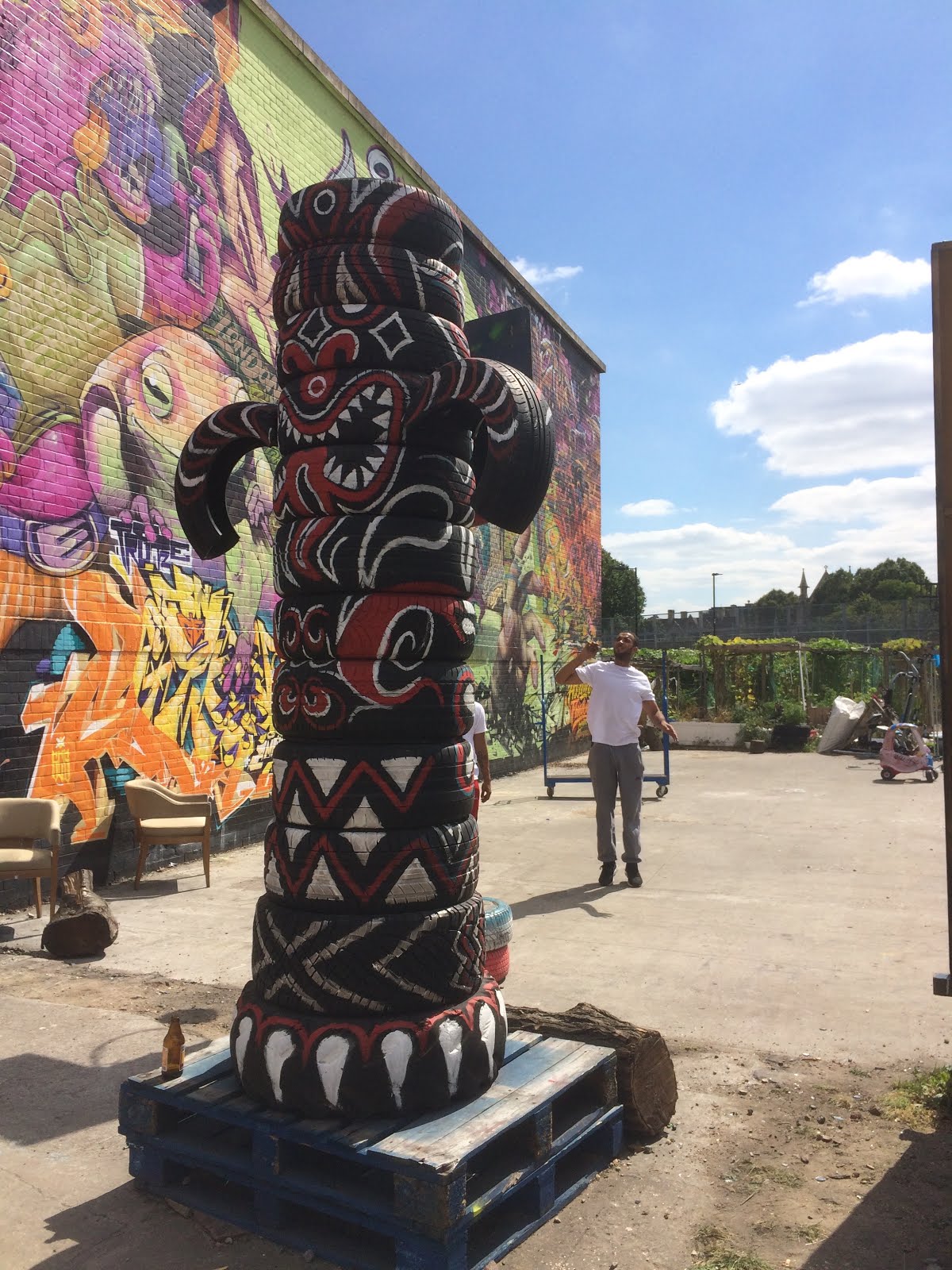


A vulture, perhaps. A scavenger bird, made from scavenged materials.


The Gardens are often used for concerts and other events. And soon they will have a theatre. This domed wooden building was a bit of a surprise. It wasn't there when I had visited last year, and unlike the other structures, which were attractive but had a makeshift quality, this was a finely crafted construction, a wooden rotunda with a domed roof.


The theatre is the work of a talented chap called Selim, and he is building it all on his own. Here he is, working inside. He does this sort of thing for a living as well, and describes himself as a man with OCD, "obsessive construction disorder".


All the material for the construction was salvaged. Nothing was bought. The building is made entirely of wood, which makes for good acoustics. I thought the acoustics were pretty good, but I was assured that they would be even better after the oculus at the top of the dome had been covered with perspex.

The theatre should be completed in a few weeks’ time, I was told. The plan is to have an inaugural concert of operatic works. That sounds like a terrific idea. I don't like the way classical music gets poshed-up, and I think that the Nomadic Community Garden would be an excellent setting for a bit of opera. I hope I'll be able to attend.


Related:
My previous post about the Nomadic Community Gardens.
Another pop-up garden: The King's Cross Skip Garden


Nomadic Community Gardens
Fleet Street Hill
London E2 6EE
Usually open daily until about 11 pm.
Also on Facebook and Twitter

Thursday, 27 August 2015

The amazing Nomadic Community Garden in the heart of London's East End

A magical inner city oasis for the local community in East London

As I was strolling around Brick Lane last Saturday afternoon, my eye was caught by a sign that said "Nomadic Community Garden".


My curiosity piqued, I followed the sign and found myself walking into a large open space. Just beyond the entrance was an enormous sculpture of a horse, and next to it an old fishing boat.


Further on there was outdoor furniture made from recycled pallets, old tyres, and so on.


There was street art on the walls around the compound.


In the middle of the area there was a portakabin with a covered area in front of it, where a few people were sitting and chatting. Beyond that, more open space with more informal seating, and a large wall at the very end with an enormous mural.


I got chatting to the people by the hut and learnt more about the project from James, who turned out to be one of the founders of the project. Prior to this he had worked as a labourer,  in theatres, on organic farms, and in other jobs, in England, Berlin and Copenhagen, acquiring along the way the skills and ideas for this scheme.

This site had been derelict for 20 years, and had been acquired by LondonNewcastle for development. The developers have allowed Nomadic Community Gardens to use the area until construction begins, and they have been very supportive. The Gardens have been there since May.

The gardens themselves are allotments that have been made available to the local community free of charge. It's a very clever concept.  Using modular raised vegetable beds that can be lifted with forklift trucks on to lorries for transportation, they can be deployed almost overnight, which is what happened here.

The allotments were heavily cultivated by the locals, many of whom were from the local Bangladeshi community, and originally from rural areas. When the project was starting up, the organisers chatted to the local residents in the surrounding streets. Word spread and all the units were snapped up. The place was clearly well loved and well maintained. I'm not one for gardening myself, although I appreciate and admire the effort that others put into such activities, and to my inexpert eye, all the vegetation in the units looked green, lush, healthy and abundant.


In addition to the allotments, there is a park and play area, an events space, and a library. There's also a beehive, which they hope will eventually produce honey.


The street art had created by artists who learnt about the project. The giant painting on the end wall was being worked on while I was there. I was told that this was the largest open air art gallery in London.

The very impressive giant horse at the entrance had been constructed from salvaged materials by an artist who had turned up and looked around, and apparently it had been done without any preparatory drawings.

Everything here has been made from material that has been donated, salvaged, or recycled.


The boat was from Norfolk, and had been due to be scrapped. Instead, it was brought down to the garden and will be made into a play area. The hull is in reasonable shape but needs repainting. The wheel still turns the rudder, which I thought was delightful. The floorboards are gone and will need to be refitted. I wasn't so keen on their plan to cut a hole in the hull for people to climb through, but I guess it will be fun for the kids. They liked my idea of a mast with crosstrees from which they could fly signal flags. I thought what would really be fun would be if it were to be set up so that the children could scramble up the rigging, like on a tall ship, but I didn't mention that.

It's a wonderful, uplifting and enchanting place. It reminded me a little of the city beaches I had seen in Berlin, and a little of Womad, the world music festival. They have succeeded in creating a socailly and biologically diverse "third space" for the benefit of the community.


The plan is for some of the funding to come from hiring out the events space for events, fairs and performances. There was nothing on when I visited, but there was an art fair the following day, and another event is planned in support of bees.

This is an excellent way of making use of derelict land for the benefit of the community, and it's been set up independent of local authority organisation or funding. It's a model that could be replicated everywhere. There are always plots of land, some derelict, some unused, some awaiting development. This is a clever way to use them for everyone's benefit. If and when the land is required for other purposes, the garden can be demounted and moved elsewhere.


The project is run by volunteers, and does rely on contributions. If you'd like to contribute your time, skills, materials, or money, have a look at their website, or drop in. They are trying to raise £13,320 by the end of September; LondonNewcastle have contributed £2000. They still need about £10,000. Please help if you can.

Fleet Street Hill
London E2 6EE

Usually open daily until about 11 pm.


https://www.facebook.com/nomadiccommunitygardens


Update. 1 October 2015: 
I haven't been back to the Garden, but unfortunately they failed to raise the required money from their appeal.
Quite by chance, I visited another sort of pop-up, temporary community garden, also on a building site. Read about it here.

Update. August 2016:
I revisited the garden and wrote about it here.