Showing posts with label naval history. Show all posts

Friday, 22 April 2016

Book Review: City of Fortune: How Venice won and lost a naval empire, by Roger Crowley

A well-written and engrossing account of the rise and decline of the Venetian empire
As this year’s birthday present from my wife, I will be receiving in the post one book every month from Daunt Books, selected personally by their staff, based on the things that interest me. The first book to arrive was City of Fortune, by Roger Crowley, the story of “How Venice won and lost a naval empire”
Venice grew from a small settlement built on marshy islands in a lagoon, to become a wealthy trading city, controlling much of the trade between East and West. This was inextricably linked with sea power, and Venice was in the middle ages the greatest naval power in Europe and the Mediterranean. There are lots of books about Venice, but I don't know of any other popular (i.e. non-academic) histories that tell the story of the Venetian maritime empire.
The book covers the period from around 1000 to around 1500. In the early years, the Venetians subdued the pirates around the Adriatic and became the dominant naval power in their area. Then in the early 1200s they got involved in the notorious Fourth Crusade, when they were engaged to transport the crusaders to the Holy Land. As part of the deal, they stopped along the way of to reassert their authority over their possessions in the Adriatic. As a result of various intrigues, involving rival claimants to the Byzantine throne, the crusader force ended up at Constantinople, at that time the greatest and richest Christian city on earth. Constantinople was attacked, sacked and plundered in 1204. The crusaders never made it to Jerusalem. The Byzantine Empire was fatally weakened, while Venice became rich on the loot, acquired more colonies, and became even more powerful.
It goes on to tell the story of how the Venetians overcame other rivals in the Mediterranean, notably the Genoese, who came close to conquering and occupying Venice itself. Ultimately Venice triumphed. Although the Genoese were more than a match for them militarily, the Venetian state was better organised and more stable, which made all the difference in the long run. Then the Ottoman Turks became the dominant power in the Mediterranean and by the 1500s, the days of Venetian naval supremacy were over. Venice would still be prosperous for many years, until Napoleon invaded in 1797, but the days of glory were over, and the slow decline had begun.
The book is written in a fast-paced style, at times almost like a novel, and I found it an easy and entertaining read. Incidentally, although it might look like a naval history, it's aimed at the general reader, not the naval enthusiast. There were several things about it which made an impression on me. 
I had known the story of the Fourth Crusade in outline. The Venetians were at that time the only people with the resources to transport a large crusader force by sea across the Mediterranean However I had not appreciated the extent to which for Venice it had been such a high-risk undertaking. More or less the entire economy of the Republic had to be diverted towards the enterprise.
I knew of the Venetian possessions in the Mediterranean, which even today have Venetian buildings and clock towers, and which display the winged lion of St Mark, the emblem of Venice. However, I had not appreciated how badly the local inhabitants in their colonies were treated. We are often told how, compared to the chaotic despotism elsewhere in Italy, Venice was a model of enlightened good government (for that time). This did not apply in their colonies, which were regarded as purely economic and military resources. In their colony of Crete, the Venetians were hated by the locals. There were frequent revolts, which were put down harshly.
We live in troubled times today, with unpleasant conflicts around the world, in which innocent civilians are bombed and killed. Reading this book reminded me that things in the past were much worse. They may not have had the means to wreak death and destruction on a massive industrial scale as we do today, but they were pretty horrid. Wholesale massacres seem to have been the norm during warfare. Torture was accepted as routine. Prisoners captured by the Turks might be impaled or sawn in half. Turkish pirate chiefs who were captured by the Venetians were roasted alive at the end of an oar.
We might talk of cut-throat business practices, but this was often literally true for merchants in the middle ages. Life for them could be dangerous, with the constant threat of piracy at sea, periodic fights between merchants from different countries, and the risk of imprisonment, or worse, if they were abroad when the political climate changed. Being an aristocrat was no protection. Venice in the middle ages might have been one of the richest and most powerful states, but even for the well-off, things were pretty tough and precarious.
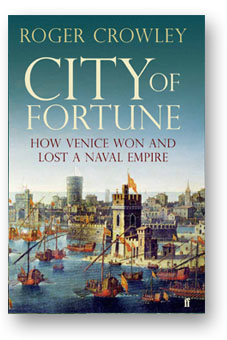
City of Fortune: How Venice won and lost a naval empire, by Roger Crowley.
http://www.rogercrowley.co.uk/city.htm
This the sort of subscription I received for my birthday:
https://www.dauntbooks.co.uk/products-page/subscriptions/


Friday, 12 February 2016

The Battle of Pulo Aura

Napoleonic-era Valentine's Day action at sea, off the coast of Malaysia

Pulau Aur is a beautiful island on the South China sea, about 70 km off the east coast of Peninsular Malaysia, with beautiful white beaches, clear water, and an abundance of marine life, popular with tourists, divers and fishermen.


I was there in the late 1980s on a memorable sailing trip on board a large catamaran. It was less developed in those days. I recall an overnight sail with gentle winds during which when we slept on deck when off watch, buying coconuts from a local who came up to sell them from his boat, attempting to make our own sushi from fish we caught, and generally having a good time, as well as some rather heavy weather on the way back to Singapore.

It was only recently that I discovered by chance that the area had been the scene of a Napoleonic naval engagement, known as the battle of Pulo Aura, which took place on 15 February 1804, in the year before Trafalgar.

At that time, trade with India and the Far East was of vital importance to the British economy. India was run by the East India Company. The Company had a fleet of armed merchant ships known as East Indiamen, which carried its goods and passengers. In the time of Nelson and Napoleon, the fighting power of ships was described in terms of the number of guns they carried. The most common large warship (or ship of the line) carried 74 guns. East Indiamen carried up to 36, but the guns were inferior to those of naval vessels, and their crews smaller and less well trained, so while they might be able to defend themselves against pirates or smaller armed vessels, they were not meant for serious naval engagements. However they were painted to look like naval vessels, with extra gunports and dummy cannon, so that they could be mistaken from a distance for more powerful warships. The deception could be effective. In 1797, in the Bali Strait Incident, a French naval squadron was fooled into thinking that a convoy of East Indiamen was a British naval force, and they withdrew without a fight.

The East Indiaman Warley, which took part in the events described. 
Robert Salmon, 1801, National Maritime Museum

Every year, a convoy known as the China Fleet, consisting of East Indiamen, as well as smaller merchant vessels, would sail from China and other Far Eastern ports, laden with cargo bound for England. In 1803, Napoleon dispatched a squadron under the command of Admiral Charles-Alexandre Durand Léon Linois to the Indian Ocean to raid British commerce. Notified of the departure of the China Fleet by Dutch informants, Linois set out in search of it.

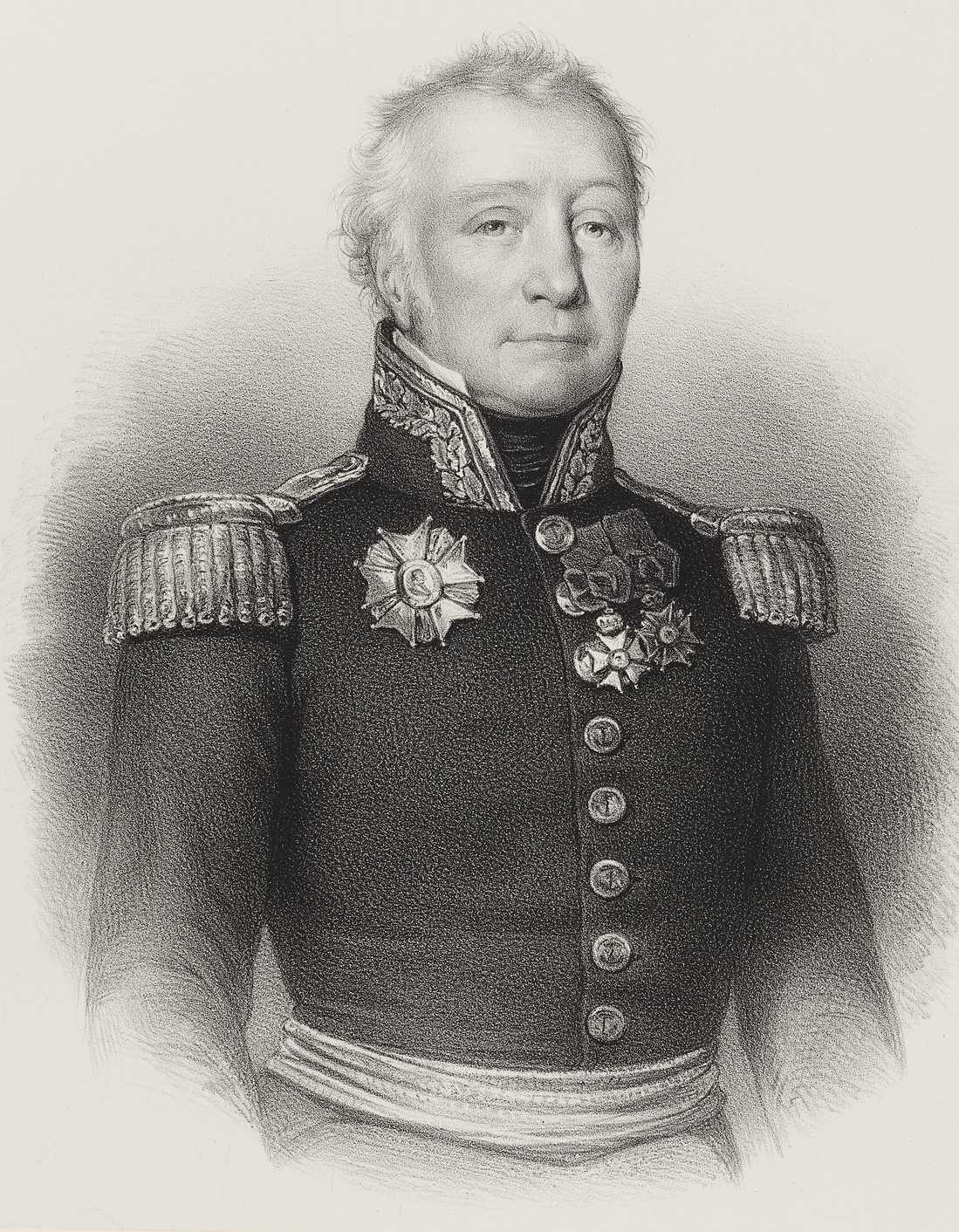
Charles-Alexandre Durand Léon Linois, by Antoine Maurin 

In January1804, the convoy sailed from Canton under the command of Nathanial Dance with an immensely valuable cargo the included tea, silk, and porcelain. In addition, there were 80 Chinese plants ordered by the naturalist Sir Joseph Banks for the Royal gardens, and transported in a special plant room. The only naval vessel accompanying the convoy was a small brig, a 2-masted vessel more suited to carrying messages than fighting in fleet actions.

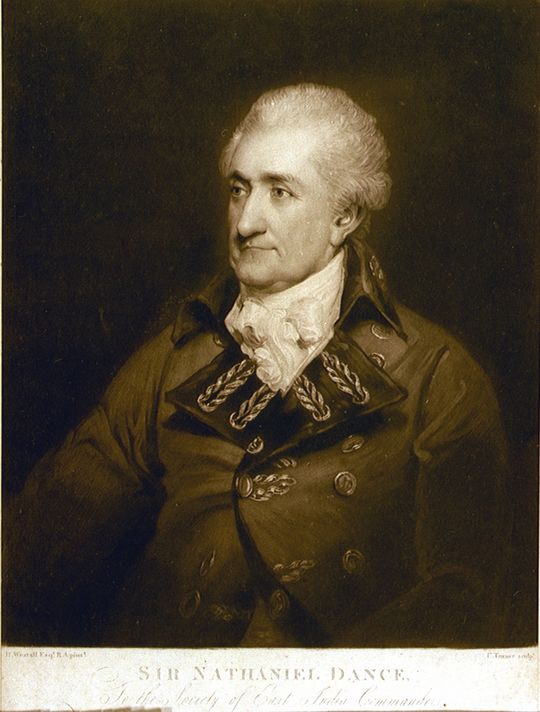
Nathaniel Dance

On the morning of 14 February, within sight of Pulau Aur, sails were sighted by the convoy. Dance sent a few of his ships to take a closer look, and found that this was a French naval squadron consisting of a 74-gun ship of the line, and four smaller vessels of 40, 36, 20 and 16 guns. This was a serious naval force, powerful enough to capture the valuable convoy.

Dance cleared his ships for action, and by 1300 the East Indiamen were deployed in line of battle, the fighting formation used by navies of the day. Linois closed in behind the slower merchant ships, but instead of attacking them immediately, he merely observed. Dance took advantage of the delay to move the smaller unarmed ships to the opposite side of his line, so that his armed vessels were between them and the French. At the same time he gathered volunteers from their crews to supplement the strength of his East Indiamen.

At dawn the following morning, both sides hoisted their colours. Dance had the larger British vessels fly naval ensigns to deceive the French into thinking that they were part of a larger British squadron known to be operating in the Indian Ocean. Uncertain as to the nature of the British ships, the French kept their distance, but as the British fleet redeployed into a sailing formation to continue their journey, the French approached more closely.

By 1300 Dance realised that the French might catch up with the ships at the rear of the convoy, so he ordered his leading ships to turn around and come between the French and the convoy. At 1315 the shooting commenced.

The Indiamen (centre), engage the French (left), and protect the unarmed merchant ships (right)


No serious damage was inflicted on either side, and the only casualties were British: one killed and one wounded, but after 45 minutes, Linois ordered his ships to withdraw from the action and sail away as fast as they could. In order to maintain the pretence that they were warships, and to discourage the French from returning to attack, Dance ordered those ships flying British naval colours to give chase, even though there was no hope of catching the faster French ships. They chased the French for 2 hours before re-joining the convoy. By 2000, the entire convoy was safely at anchor at the entrance to the Straits of Malacca, and they made it back to England without further incident.

The convoy was valued at over £8 million, equivalent to £600 million in today’s money. The loss of the convoy might well have resulted in financial ruin for the East India Company and as well as for Lloyd’s, the underwriters. The captains and their crews were highly praised, and rewarded with prize money and gifts. Nathaniel Dance was knighted, and retired from the sea to Enfield Town, where he died in 1827. The unfortunate Admiral Linois did not have much success after this, and was captured in 1806 when he mistook a powerful British naval squadron in the middle of the Atlantic for a merchant convoy.

Here is Dance's dispatch describing the events:


If you'd like to read a more detailed account of the battle, see Wikipedia.
And finally something else from that convoy which was carried aboard the Warley, the ship illustrated above: an early Chinese music book. http://www.thehistoryblog.com/archives/date/2014/03/09