Showing posts with label eatables and drinkables. Show all posts

Friday, 7 October 2016

London Design Biennale 2016: Lebanon and South Africa

A Beirut Street, and Giant Stuffed Animals

At the first London Design Biennale, held at Somerset House from 7 - 27 September this year. There were 37 countries represented, each with their own installation, on the theme of Utopia. The exhibits ranged from the highly conceptual, to collections of practical objects. I thought it was a good selection, and immensely enjoyable.

Here are two of them, to begin with.

Lebanon
Mezzing in Lebanon

This was a delightful outdoor installation on the terrace, a re-creation or re-imagining of the streets of Beirut, with a barber shop cum mini-cinema, rooms for relaxing and playing board games, a quilt maker, and food and drink stalls.


The food was by a well-known London restaurant, Momo. I have never been to Momo, but the shawarma was delicious, so it's on my list. I've never been to Beirut either, but now I'm curious, and the UK government advice is that it's only moderately dangerous, so we'll see.


South Africa
Otium and Acedia

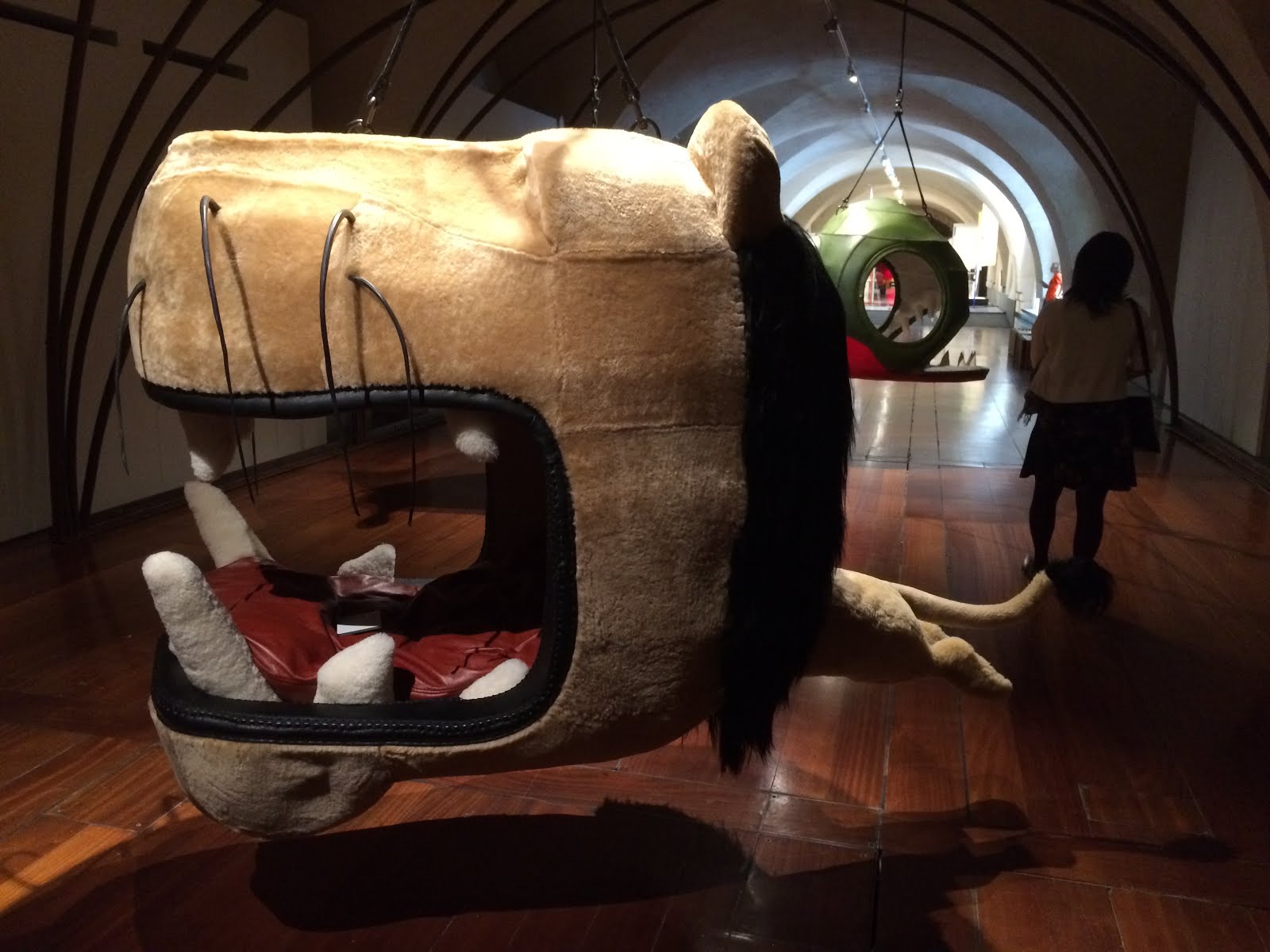
Hanging nests in the form of ferocious animals. They were charming and funny.


I'm sure, like me, everyone must have been wondering what they would be like to sit in, but that was forbidden. This was as close as I got.


You can see more of the designer's work in his website, which is worth a visit.

That's all for today.
More next time.

Thursday, 23 June 2016

Things I have been enjoying in Prague

I'm now into the second week of my trip to Prague (of which most of the first week was spent attending a medical meeting). Prague is, of course, a well known and popular tourist destination. However, some of the things I have particularly enjoyed are not necessarily those which get the most attention in the guide books.

Architecture

Prague is well known for its historic centre, with it's mediaeval towers, baroque architecture, castle, and the famous statue-lined Charles Bridge, and these are marvellous. However, there is another aspect which I found particularly interesting: the early modern architecture.

Cubism arose in France, and the art movement spread elsewhere in Europe, but it was only the Czechs who extended it to include furniture, household items, and architecture. This was a short-lived movement, which began around 1912 and lasted for only a few years until the mid 1920s, but today you can still see cubist buildings in good condition. In one of them, the so-called House of the Black Madonna, there is a delightful cafe on the first floor with a cubist interior and cubist furnishings, the Cafe Grand Orient. Above this is the Museum of Czech Cubism, and on the ground floor is the Kubista shop where you can buy replicas of cubist design.


Here are pictures of the exhibits in the museum, from my Facebook gallery (please feel to follow me on Facebook):


Here are some cubist buildings I saw in Prague:


The Czechs took to modernism in a big way after The Czechoslovak Republic was formed in the aftermath of the First World War and the break-up of the Austro-Hungarian empire. As I understand it, this was one of the ways in which the new democratic republic could distinguish itself from the backward empire from which it had been liberated. 

There were later developments from cubism, such as "rondo-cubism", and later on there were Art Deco and modernist buildings. Prior to Cubism, there was Art Nouveau and Historicst architecture during the late 19th and early 20th centuries, a lot of it around, varied and and fascinating to look at.


Beer

As a beer enthusiast living in England I have been drinking rather more ale than lager. Here in Prague it has been once to drink good quality lager for a change. In particular, I have enjoyed drinking the dark beer, which is not widely available in Britain. Contrary to what you might expect, the dark beers are not at all heavy, and you should not be misled by the colour. 


Quite a few of the bars here serve beer "from the tank", which has not been subjected to the usual preservative processes, giving a better and fresher taste. It's worth keeping an eye out for the words "tankova" or "tanku" outside a bar which inform the prospective customers of the availability of this sort of beer. They also serve unfiltered (nefiltrovane) beer, which I rather like. 

Lemonade

Prague is associated with beer, but they also do a great line in non-alcoholic drinks, specifically the local "lemonade". Most bars and restaurants serve lemonade which over here means a refreshing drink, made on the premises, flavoured with a variety of fruit, and not too sweet. It's more intensely flavoured than those flavoured bottles of mineral water that you get in Brtiain and elsewhere, but less so than English lemonade. We plan to try making it at home when we get back. 


Coffee

Most places seem to serve the usual espresso-based stuff, generally of a reasonable standard, but you can still get the old-fashioned Czech preparation known as Turecka, or Turkish coffee in the English-language menus, which is the Czech version of Turkish coffee. It's black coffee served in a glass with the grounds still in, rather like cafetière or so-called French press coffee, but without the plunger and filter. If you want a long coffee, it's a good alternative to an americano, and less bitter. I like it and I wish it were more widely available.


Food

Eastern and Central European food seems to have a bit of a poor reputation in English speaking countries but I think this is due to ignorance. I haven't sampled the whole range of the local cuisine, but what I've had I have liked. There's a lot of pork, often with lots of sauce, and often accompanied by dumplings. There are different sorts of dumplings, including one which are rather like bread and excellent for soaking up the gravy.


There are some unusual dishes, such as Svíčková, beef served in a creamy, sweetish sweet sauce, served with cranberries, and whipped cream. It's strange, but enjoyable.
Another popular dish is cheese fried  in breadcrumbs, served with tartare sauce which is delicious.
Both are illustrated below. 


Some of the bar snacks are pretty unusual as well. Cheese soaked in oiled and spices, pickled sausages and so on. The ones I have tried have been great, and I hope to try more during this trip.


I should also mention the wonderful open sandwiches, sold in cafes at lunch time, of which I illustrate a small selection.


So far I have been having a rather nice time. I find Prague a very congenial place, and there is lots more to see and do than I have described here. I fancy I would like to make a return trip in the not too distant future.

Friday, 17 June 2016

Coffee pod machines: Nespresso vs Dolce Gusto


I'm currently in Prague attending a radiology congress, staying in an AirBnB apartment. This one is comes equipped with a Nescafé Dolce Gusto coffee machine. As it happens, the last AirBnB apartment I stayed in, in Vienna, where I was attending another radiology congress, came with a Nespresso machine. I have thus had the opportunity to compare the two systems.

I did wonder a little about the difference between the two products, as both used capsules made by Nestlé. Of the two, Nepresso is the better known and more heavily advertised, endorsed on television by the likes of George Clooney. With Nespresso, you can get an enormous range of different coffee capsules, including limited-edition temporary ones. There are grand, swanky Nespresso shops, and although the machines vary in price, they are clearly aimed at the higher end of the market, with some concessions for buyers lower down the food chain. It is said that some upmarket chefs use Nespresso machines in their restaurants since they work out cheaper than hiring a barista.

Dolce Gusto machines seem to be aimed at the more modest end of the market, and they are cheaper than the Nespresso equivalents. The range of capsules is more limited, but the machines also make cold drinks and tea. You can get also get capsules for things like cappuccino, with one coffee pod and one milk pod, whereas with Nespresso it's coffee only, and you have to add the milk yourself. Dolce Gusto machines and pods all have the word Nescafé displayed prominently in their packaging and advertising, so the product is clearly aimed at people who are not snotty about instant coffee.

The machines vary slightly in the way they are operated, but both are quick and simple to use. What about the coffee? I tried a range of pods from Nespresso when I was in Vienna. In my current apartment I have so far tried the standard espresso, lungo and cappuccino pods. I think the Dolce Gusto coffee is pretty good, with a mellow, rich flavour. It's every bit as good as Nespresso, and better than some of the Nespresso capsules I have tried. 

If you wanted to buy a coffee capsule machine for your small office, Dolce Gusto might be a better choice because the coffee would be just as good as that from Nespresso, if not better, and you'd be able to get a wider variety of beverages, like caramel latte macchiato, or Marrakesh style tea.

If you really wanted to be able to choose from a really wide selection of pods, you might be prepared to pay the premium for a Nespresso, but then if you cared that much, perhaps you'd want to prepare the coffee yourself from beans, with a proper coffee maker. Of course there's more snob value to a Nespresso, and I'm sure that would mean a lot to some people, the sort that used to scoff at the Iron-Curtain era Skoda I used to drive. 

Would I get one of these? I think not. I've owned earlier versions of coffee pod machines in the past, but now my preferred method of making coffee at home is a plunge pot, also known by some people as a "French Press" (although as far as I know it's not a French invention). 40-50 g of coffee in 1.25 litres of water at 93C gives good results. My preference is for full bodied coffee with low acidity. Currently I'm drinking Orang Utan, from Sumatra, which is excellent and whose profits help to fund Orang Utan conservation. If you can't get hold of it or want something more economical, IKEA dark roast is excellent. If I want espresso at home, I do have a Rok, a British-made device which works rather well (see link). Capsule machines are convenient but they work out quite expensive, and generate more waste, even if some of the capsules can be recycled to some extent. My current system works well for me at home, so even though I've enjoyed using these gadgets while away, I won't be buying one.

Thursday, 19 May 2016

Boiled lamb

Originally an English dish, mostly eaten in France these days, it seems.

I’m not quite sure why, but I'm rather curious about the old English dish of boiled mutton and caper sauce. Perhaps it’s a vision of the sort of people you see in Rowlandson cartoons or Hogarth paintings tucking into vast joints of meat, washed down with several pints of claret.

The Dinner. From 'The Comforts Of Bath'. Thomas Rowlandson (1756-1827). 
Handcoloured Aquatint, 1798.

According to a 2014 BBC Radio 4 documentary, mutton was highly prized in England until the 19th century, but fell out of favour and was replaced by lamb. This was partly to do with the fact that good mutton was delicious, but poor quality mutton could be very tough, whereas lamb was more consistent in its quality. In the 1960s and 1970s, the invention of synthetic fabrics lead to reduced demand for wool, which pushed sheep rearing into further decline

There have been some efforts to promote a revival of mutton, but as far as I can tell it doesn't seem to have caught on so far. I haven’t seen it on restaurant menus except in stews, and they don’t sell mutton in my local supermarket. I might try to get it from a halal butcher. According to the radio programme, the mutton sold in halal shops is fresh, and not aged in the way it would be in the English tradition, but it's worth a try, I think.

I have, however, had boiled leg of lamb, from a recipe in French Home Cooking by Paul Bocuse.


Boiled lamb seems also to have died out in England but it's a French classic, known as “gigot à l’anglaise”. Incidentally, according to various surveys, the most popular French dish is steak and chips, which may also be of English origin, as suggested by in this 17th century menu which I saw at the Musée Cognacq-Jay, listing “beef-stakes”, as well as "rosbiff".


Last weekend I thought it would be nice to have boiled leg of lamb, but the Bocuse cookbook had been packed away in anticipation of an impending house refurbishment, so I looked online for guidance. Based more or less on this recipe, I put chopped carrots, an onion studded with cloves, some celery, a head of garlic, a bay leaf, a bunch of parsley, and some fresh rosemary into a pot. I had planned to add a stock cube, but while shopping for the lamb, I found that my local Morrison’s supermarket had some lamb bones, so I used those instead. (My branch of Morrison’s are very good in that way: they regularly stock marrow bones, beef bones, chopped heart, and so on).


After adding water and bringing the whole lot to the boil, I simmered the lamb (a 1 kg leg portion, just right for two people) for about an hour. The recipe recommended 15-20 minutes per 500g but I had made a mistake and overdone it a bit. The meat was delicious and tender nevertheless. It's clearly a robust and forgiving method of cooking.

Previously, I had served the lamb with sauce gribiche, in accordance with the recipe in Bocuse. It had been a very good accompaniment but now I wanted caper sauce, which I had read about, but never before tasted. Using a recipe from the Guardian, I made the caper sauce with butter, cream, lamb stock from the cooking pot, parsley and lemon juice. I added rather more capers than they advised, which a good decision. The quantity of sauce was meant for eight people, but we found it about right for the two of us.


Served with boiled carrots and Jersey Royals, this was an excellent dish. I imagine the technique would suit the stronger and fuller flavour of mutton, and I must try that some time.

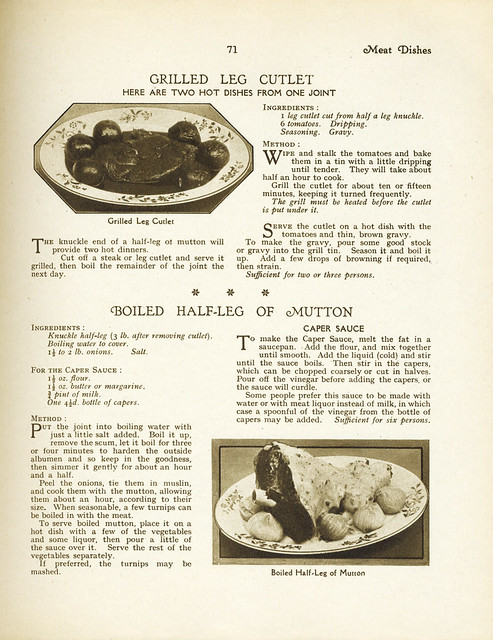
Just to finish off, this is a recipe I found on Flickr from the Bestway Cookery Gift Book (Fourth Book), published in 1929, in England.

Bestway Cookery Gift Book - Boiled Leg of Mutton

I think a bit of French influence has been a good thing as far as this English dish is concerned.

Thursday, 10 March 2016

Otto Wagner's stunning Postal Savings Bank (Österreichische Postsparkasse) in Vienna

Over a century after it was built, this masterpiece still looks and feels totally modern

Anyone with an interest in design who travels to Vienna will probably want to visit MAK, the Museum of Applied Art. Established during the Hapsburg period and consciously modelled on the Victoria and Albert Museum in London, MAK hosts an impressive permanent collection, including a superb section devoted to the 1900s, as well as temporary exhibitions of excellent quality.

Diagonally across the road from MAK is the Österreichische Postsparkasse (Austrian Postal Savings Bank), one of the most important works of early Austrian modern architecture, designed by Otto Wagner. It's easily overlooked by the casual visitor, but is in my opinion one of the most beautiful buildings in the city.

It is constructed from concrete but clad in stone and marble slabs, held in place by aluminium-coated iron nails, which produce a striking visual effect.


In the entrance, an inscription informs the visitor that it was constructed during the reign of His Royal and Imperial Apostolic Majesty Franz Joseph I by Otto Wagner between 1904 and 1906.


The main hall, which is the public area, is stunning. It is flooded with diffuse light, the result of the glass ceiling and the prismatic glass tiles on the floor, the latter also serving to illuminate the original sorting offices below. These were great technical innovations in their day, and the effect remains startlingly modern over a century later. Everything has been carefully and beautifully designed, from the radiator shafts, to the furniture, to the smallest details of ornamentation.


There is a museum at the back of the entrance hall which is well worth visiting. It contains an excellent historical display, as well as a reconstruction of the original cashiers' desks.


There were some rather unfortunate alterations in 1975, but the entrance hall was refurbished some years ago and restored to its original appearance, with some modifications for modern banking technology, and I think they have done an excellent job.


Unlike some other museums, in this one you can sit on the Otto Wagner chairs, both in the museum as well as in the working area of the bank, and even carry out real banking transactions.


As a reminder of how advanced Otto Wagner was, you can see, directly across the road on the other side of the square, the former Imperial and Royal War Ministry, a grandiose and bombastic confection with the biggest imperial eagle I've ever seen, built in 1909-1913, several years after Wagner's building was completed.


It does have some rather amusing military heads over the ground floor windows, though.


The museum has an excellent and informative website with more information about the architect, the building, and the bank, in English and German: 

Should you feel hungry, the food at the Cafe Ministerium on the square by the bank is excellent. 


The cafe at MAK is very also very good. Directly across the road from MAK is the elegant Cafe Prückel. If you are really starving and fancy a blow-out meat-fest, then Plachutta, the temple of tafelspitz, is just across the square from the Prückel, so you'll be spoilt for choice.

Museum Postsparkasse
Georg Coch-Platz  2, 1018 Vienna
Open Mon - Fri, 1000 - 1700