Showing posts with label drink. Show all posts

Thursday, 23 June 2016

Things I have been enjoying in Prague

I'm now into the second week of my trip to Prague (of which most of the first week was spent attending a medical meeting). Prague is, of course, a well known and popular tourist destination. However, some of the things I have particularly enjoyed are not necessarily those which get the most attention in the guide books.

Architecture

Prague is well known for its historic centre, with it's mediaeval towers, baroque architecture, castle, and the famous statue-lined Charles Bridge, and these are marvellous. However, there is another aspect which I found particularly interesting: the early modern architecture.

Cubism arose in France, and the art movement spread elsewhere in Europe, but it was only the Czechs who extended it to include furniture, household items, and architecture. This was a short-lived movement, which began around 1912 and lasted for only a few years until the mid 1920s, but today you can still see cubist buildings in good condition. In one of them, the so-called House of the Black Madonna, there is a delightful cafe on the first floor with a cubist interior and cubist furnishings, the Cafe Grand Orient. Above this is the Museum of Czech Cubism, and on the ground floor is the Kubista shop where you can buy replicas of cubist design.


Here are pictures of the exhibits in the museum, from my Facebook gallery (please feel to follow me on Facebook):


Here are some cubist buildings I saw in Prague:


The Czechs took to modernism in a big way after The Czechoslovak Republic was formed in the aftermath of the First World War and the break-up of the Austro-Hungarian empire. As I understand it, this was one of the ways in which the new democratic republic could distinguish itself from the backward empire from which it had been liberated. 

There were later developments from cubism, such as "rondo-cubism", and later on there were Art Deco and modernist buildings. Prior to Cubism, there was Art Nouveau and Historicst architecture during the late 19th and early 20th centuries, a lot of it around, varied and and fascinating to look at.


Beer

As a beer enthusiast living in England I have been drinking rather more ale than lager. Here in Prague it has been once to drink good quality lager for a change. In particular, I have enjoyed drinking the dark beer, which is not widely available in Britain. Contrary to what you might expect, the dark beers are not at all heavy, and you should not be misled by the colour. 


Quite a few of the bars here serve beer "from the tank", which has not been subjected to the usual preservative processes, giving a better and fresher taste. It's worth keeping an eye out for the words "tankova" or "tanku" outside a bar which inform the prospective customers of the availability of this sort of beer. They also serve unfiltered (nefiltrovane) beer, which I rather like. 

Lemonade

Prague is associated with beer, but they also do a great line in non-alcoholic drinks, specifically the local "lemonade". Most bars and restaurants serve lemonade which over here means a refreshing drink, made on the premises, flavoured with a variety of fruit, and not too sweet. It's more intensely flavoured than those flavoured bottles of mineral water that you get in Brtiain and elsewhere, but less so than English lemonade. We plan to try making it at home when we get back. 


Coffee

Most places seem to serve the usual espresso-based stuff, generally of a reasonable standard, but you can still get the old-fashioned Czech preparation known as Turecka, or Turkish coffee in the English-language menus, which is the Czech version of Turkish coffee. It's black coffee served in a glass with the grounds still in, rather like cafetière or so-called French press coffee, but without the plunger and filter. If you want a long coffee, it's a good alternative to an americano, and less bitter. I like it and I wish it were more widely available.


Food

Eastern and Central European food seems to have a bit of a poor reputation in English speaking countries but I think this is due to ignorance. I haven't sampled the whole range of the local cuisine, but what I've had I have liked. There's a lot of pork, often with lots of sauce, and often accompanied by dumplings. There are different sorts of dumplings, including one which are rather like bread and excellent for soaking up the gravy.


There are some unusual dishes, such as Svíčková, beef served in a creamy, sweetish sweet sauce, served with cranberries, and whipped cream. It's strange, but enjoyable.
Another popular dish is cheese fried  in breadcrumbs, served with tartare sauce which is delicious.
Both are illustrated below. 


Some of the bar snacks are pretty unusual as well. Cheese soaked in oiled and spices, pickled sausages and so on. The ones I have tried have been great, and I hope to try more during this trip.


I should also mention the wonderful open sandwiches, sold in cafes at lunch time, of which I illustrate a small selection.


So far I have been having a rather nice time. I find Prague a very congenial place, and there is lots more to see and do than I have described here. I fancy I would like to make a return trip in the not too distant future.

Friday, 11 December 2015

Drinky-poos in Venice

Cocktail time in Venice is bright orange

The visitor to Venice with the even slightest interest in drink will notice on practically every table and bar counter glasses of filled with an enticing orange liquid. This is the Spritz, which these days seems to be the drink most closely associated with Venice. 
Campo San Barnaba, Venice.
3 glasses of Spritz. The item in my hand is a selfie stick. 
(Picture cropped to preserve the anonymity of my companions)
A spritz is made from white wine or prosecco, a splash of soda water, and a "bitter", usually Aperol. It’s served over ice, usually garnished with a green olive at the end of a long stick, and /or a slice of orange or lemon, and makes a delightful aperitif, light and refreshing, sweetish, a bit orange-y (or is that the colour influencing my perception?) , with a little bitterness. 
The spritz has its origins in the period when Venice was ruled by the Austrians, and derives from the Austro-Hungarian habit of mixing wine with sparkling water to make a Spritzer. In the 20th century, Venetians began adding bitters to produce the Spritz as we know it today. Apart from Aperol, you can also have yours made with Campari (less sweet and more bitter). Or you could have it with Select, which is a little more bitter. Select was first made in Murano in 1920, and labels itself the Very Venetian aperitif. It’s difficult to find outside the area, and doesn’t even have an entry in Wikipedia. It makes a good Spritz, with a bright red colour. In recent years, thanks to intensive marketing by Campari, who now own Aperol, the spritz is available in bars all over the world, from London to Singapore, but you will probably find it difficult to to get one made with Select if you are outside the Veneto region, so you might want to seize the opportunity while you are there.

Image from 
I think the Spritz on the left is made with Select, and the one on the right with Aperol
It’s worth noting, by the way, that Aperol has an alcohol content of 11%, and Campari about twice that. I'm not sure about Select, but I think its strength is more towards the Campari end of the range. If you don't realise this, the effect can be a bit startling if you've only tried the Aperol Spritz, then decide to sample some of the other versions. You can also make a Sprtiz with Cynar, which is a bitter made from artichokes. I've only just discovered this variant, and I just remember to try one at the next opportunity.
If you want something with a bit less alcohol, you can of course have Aperol with soda, which is very pleasant. There are also soft drinks with a similar flavour, such as Sanbittèr, which make rather pleasant non-alcoholic aperitifs, so you can still sit around in a bar enjoying your bright orange drink even if you are teetotal, or below the age of lawful alcohol consumption..
One of the nice things about Venetian bars is that many of them offer a wide selection of wine, available by the glass in small measures, and at prices which are very reasonable to people from places like the UK or Singapore, owing to the different taxation policies (freshly-squeezed orange juice is usually more expensive). The bars also often have a range of delicious snacks, as described in my previous blog post on food. If you like your wine sparkling, you will be delighted to know that Prosecco is a local wine, and widely available, and you should be able to have your wine fizzy rather than still on every occasion without feeling especially self-indulgent.

Which brings us to that other Venetian cocktail, the Bellini, invented at the famous Harry’s Bar and is made from prosecco and white peach puree, with the addition of sugar syrup if the peaches are tart. I’ve been fortunate to have tried it at the establishment where it was invented, and I liked it very much. The combination of peach and prosecco was delightful.
You can also buy your Bellini ready-made in bottles produced by Cipriani (the owners of Harry’s Bar), which are pretty good. Should you wish to prepare it yourself from scratch, remember that it's not a sort of Buck's Fizz made by adding peach juice to prosecco. The Harry’s Bar website advises you to use fresh frozen white peach puree, not to use a food processor if you are making the puree yourself (as this will aerate the fruit), and to never use yellow peaches or other additives like peach schnapps. Like the Singapore Sling, it’s one of those excellent concoctions which have been brought into disrepute by improperly made versions. 
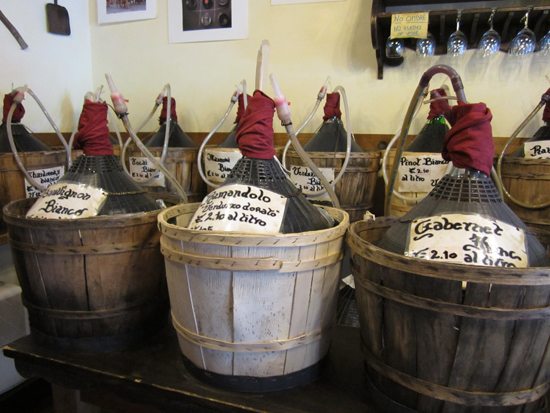
In your wanderings around the city, keep your eye out for the modest local shops, usually found in the quieter parts of town, where inexpensive but very agreeable wine is dispensed from large demijohns into the customers' own bottles (usually re-used plastic mineral water bottles).


They usually have containers to hand for people who require them, but on our last visit the shop we visited had run out of bottles, so we had to gulp down the mineral water we had on us and use the bottle thus made available. And yes, you can fill your 1.5 litre used mineral water bottle with prosecco from the tank for a very reasonable price.

That concludes my review of drinks in Venice. Cin cin!

Related post: Food in Venice - a personal view